The Island That Was Only His
RÜGEN, GERMANY (MPI) — The book was a gift from Ilona, my mother-in-law. It sits on the bookcase that holds the rest of my life with Björn: a fragment of the Berlin Wall, the topper from our wedding cake, a singing bowl we carried home from Nepal, and a book called Rügen, its cover showing a white chalk cliff beneath a Baltic sky.
Every few years I take it down from the shelf.
When people think of Germany, they tend to imagine Bavaria: mountains, beer halls, alpine villages. Rügen felt like another country attached to the edge of the same map.
In May 2012, around Björn’s thirty-fourth birthday, we took the train north from Berlin to Schwerin, the capital of Mecklenburg-Vorpommern. Lakes reflected church spires, and an impossibly ornate castle rose out of the water as though someone had misplaced it there. It still reminds me of Rapunzel.
Björn’s parents, Ilona and Wilfried, lived about forty minutes’ drive away in Kobande, in a yellow house that had belonged to Wilfried’s father. Björn and I stayed in the small villa beside it, next to the huge barn where Wilfried kept his little tractor. From Kobande we borrowed a car and drove towards the coast.
The further north we went, the flatter the land became. Water appeared unexpectedly between fields and forests. The rapeseed was out, and whole fields of yellow ran down to the water. You see a lot of it up there. We stopped to take a photo.
In Stralsund we stopped again, for the church. Inside, the brick pillars were painted white and edged in red, with gold at the top and painted figures running up their sides. Björn pointed up at the vaulting and told me that in medieval times Stralsund had been one of the richest places around. Looking at the pillars, I believed him. Architects spend an unusual amount of time looking up. Eventually the people who love architects start doing the same.
Beyond Stralsund, he named villages I had never heard of, and churches on distant skylines, before we reached them.
Years later, Ilona wrote her life down for me, in German. In 1974 Wilfried was posted to Rügen as a young officer in the East German army, at the huge barracks at Prora. They could only be placed in the same town if they were married, so they married. Ilona got a job teaching at the school in Binz. Wilfried lived in the barracks with the paratroopers. She had a room at the school with one bed, one table, one wardrobe and two chairs.
“Es kam, wie es kommen musste,” she wrote. What had to happen, happened. Björn’s sister, Katja, was born in 1976. Björn arrived in 1978.
“Er war ein Inselkind,” she told me once. He was an island child.
He went to school in Binz and knew every road and every shortcut, and which harbour sold the best fish rolls. When he was young, Ilona says, he explored everything. Near Sassnitz there’s an old castle, a ruin now, and Björn had been there. Above the kitchen door in the yellow house at Kobande there’s a small trim that came from another little castle he found.
Björn used to talk about the island in East German times, when it was where people came on holiday. That was why he went into hospitality. The Wall had already fallen by the time he started his apprenticeship as a waiter in a small hotel in Binz. Later he worked on the MS Deutschland, a cruise ship. After the ship, he decided to study architecture, first in Wismar on the Baltic coast, then in Potsdam, close enough to Berlin for the gay nightlife.
Then we crossed onto Rügen.
The first thing I remember is the blue. The Ostsee, the Baltic, barely moved. There was no surf, just a flat horizon stretching north towards Scandinavia. It hardly tasted of salt. Even in summer the water rarely warms past sixteen degrees Celsius. White chalk cliffs rose above the sea. Blue-and-white Strandkörbe, hooded wicker beach chairs, lined the beaches, and bicycles seemed to outnumber cars.
The whole place felt like a secret Germans kept among themselves. Nobody spoke English, and nobody needed to. People stopped for coffee and cake in the afternoon with an admirable seriousness. Everything moved slowly, as if the island had negotiated a private arrangement with time.
Fishermen sold Fischbrötchen from small kiosks overlooking the water. The kiosks smelled of vinegar, pickled onions, smoked fish and frying fat. I had the Fischfrikadelle, a fried fishcake in a soft roll. Björn had the same, or the Matjessalat, herring salad heaped in a roll with onion. I ate an alarming number of them.
One afternoon we stood above the chalk cliffs. The photographs in the book make them look impressive. Standing there felt different. The sea below shifted between blue and green with the light, so calm it looked painted. Somewhere behind me Björn was explaining how the Baltic came out of the ice age. I remember the ice age and not much else, except the colour, and that he loved explaining it. That happened a lot.
There were churches on the island too, perhaps several. The details have loosened with time. What remains is looking up and finding Björn already looking there first.
Another day we rented a small motorboat and headed out onto the water. From offshore the island looked softer, reduced to low green lines against the horizon. Björn looked entirely at home. I have no memory of where we were supposed to be going. What stayed was the sound of the engine and the bright Baltic light.
We slept in a hay hotel near Putbus. It was cheap, and it was an experience. We brought our own sleeping bags and climbed up into a wooden loft full of loose hay under a skylight. It was scratchy. I didn’t like it. There is a photo Björn took of me up there, eyes closed, looking completely relaxed. I was pretending.
In Putbus, I think, there was a playground duck bolted to a spring. Björn climbed onto it immediately, a grown man with his feet planted in the gravel, grinning. I took a photograph.
I have searched repeatedly for a deeper meaning hidden inside that memory. There isn’t one. I was happy.
The book remembers the cliffs, the churches and the beaches. I remember the duck, the fish rolls, and Björn looking up. Between us, we almost have the whole island.
Every year on the anniversary of Björn’s death, Ilona and Wilfried drive to Wismar and throw a bunch of flowers into the Baltic.
I close the book. A plane goes over, low, the way they do in Lilyfield, under the Sydney flight path. The evening comes through the reeded glass on my window in thin lines, gold near the sill, grey-blue above.
With thanks to Ilona Lüders, whose voice recordings and written memories are part of this story.


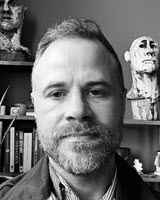
Michael Herd lives and writes on the traditional land of the Gadigal people, in Sydney. He is an educator and works at the University of Sydney. He writes creative nonfiction about grief, gay life, family, neurodivergence, and his years in Berlin. His work is forthcoming in Neon & Smoke.